

Keep politics out of football… until it’s something I agree with
By Jac Jones 26/10/26
It’s 2:30 on a Saturday, and you've had a 4-hour train journey over to the other side of the country. You and your mates have got a buzz on after drinking five beers on the train. You are all in a brilliant mood, singing with thousands of other like-minded fans that have also been up at an ungodly hour to watch your mid-table team face off against the top of the league. You know you will lose, but that doesn't matter; it's the camaraderie you're here for. Then you hear it, a man talking to his son, he's telling him a racist dog whistle about why this area of the country is worse than his area. You brush it off as you're getting off the train, and start walking towards the stadium, but on every lamppost you see a sticker with a far-right politician and something abhorrent written about asylum seekers. Again, you ignore it; it's not my problem. Finally, you are in the stadium, the crowd is loud in song, until a foreign player makes a mistake, and you then hear the same racism you have seen and heard all day. You now have two choices: do you ignore it and become complicit, or do you do the right thing and confront it?
The far-right has historically represented only a small minority within football culture. During the 1970s and 1980s, groups such as the Chelsea Headhunters and the Leeds United Service Crew became associated with far-right ideologies, shaping public perceptions of the clubs linked to them. Despite this, such ideologies were widely viewed as fringe and, for a time, appeared to be in decline.
In recent years, however, there has been a noticeable resurgence. Over the past decade to fifteen years, the broader rise in right-wing politics has coincided with a renewed visibility of far-right groups within football supporter culture. While still not representative of the majority, their presence has become more prominent.
Part of this overlap can be explained by similarities in emotional identity. Supporting a football club often involves deep loyalty, belonging, and a strong sense of collective identity, traits that can mirror the intensity of nationalist sentiment. This can foster an “us versus them” mentality among fans, typically directed at rival teams. However, this mindset can be exploited. Far-right groups have been known to shift the focus of that division away from sporting rivalry and toward wider social or political targets, reframing who “them” represents.
As a result, football environments can, at times, become spaces where political messaging is subtly introduced or normalised. While the vast majority of supporters reject such ideologies, understanding how and why these narratives can take hold remains important in addressing their influence within the game.
The far-right has long drawn support from sections of the working class, particularly targeting young men who feel overlooked or disillusioned. In the 1970s, activists from the National Front distributed leaflets on football terraces, attempting to tap into that sense of frustration and turn it into political support. Decades later, figures such as Stephen Yaxley-Lennon adopted a similar approach, presenting themselves as ordinary football fans to build backing for organisations like the English Defence League. While the individuals and groups have changed, the strategy and the audience have remained strikingly consistent.
Formed in 1967, the National Front emerged from the merger of several post-war fascist organisations, including the League of Empire Loyalists, the British National Party, and the National Socialist Movement. Its ideology centred on ethnic nationalism, anti-immigration policies, and white supremacist beliefs. Football grounds quickly became key spaces for outreach, where members would distribute propaganda and attempt to recruit supporters.
Among their materials was a youth publication called Bulldog, which notoriously included a league table ranking fanbases based on their “propensity for racist violence.” Beyond printed propaganda, the National Front also relied on visible public demonstrations. Matchdays often saw organised marches through town centres, designed not only to attract attention but to intimidate local communities.
Although the context has evolved, elements of these tactics still echo today. The methods of communication may have shifted, but the underlying approach targeting identity, belonging, and grievance, continues to play a role in how far-right groups seek to spread their message.
Moving into the early 21st century, shifting global tensions, particularly following attacks carried out by Al-Qaeda and the subsequent invasion of Iraq by the UK and US created conditions in which far-right movements were once again able to gain traction.
At the centre of this resurgence was Stephen Yaxley-Lennon, a controversial figure who presented himself as an “ordinary” football supporter, even adopting the pseudonym of ‘Tommy Robinson’ a notorious football hooligan while building a national profile. Despite a background that includes multiple convictions and personal controversies, including, assault, fraud and stalking, Yaxley-Lennon became the co-founder of the English Defence League (EDL), an organisation defined by its anti-Islamist stance and strong links to football supporter culture, particularly its more extreme elements.
The EDL effectively acted as a unifying platform, bringing together individuals from various football firms and hardline supporter groups under a single banner. This connection to existing fan networks gave the organisation a ready-made base of support. However, what set this movement apart from earlier far-right efforts was its use of digital platforms.
Capitalising on the rapid growth of social media, particularly Facebook, the EDL was able to organise, promote events, and expand its reach far more efficiently than previous groups. This marked a significant shift in strategy; from physical spaces like terraces and town centres to online communities, allowing their message to spread faster and more widely than ever before.
Decades of evolving tactics, from terrace leafleting to digital mobilisation, have culminated in a far more visible and adaptable far-right presence in 2026. What was once confined to the fringes of football culture has, at times, edged closer to the mainstream, not necessarily through mass support, but through increasingly sophisticated methods of engagement and influence.
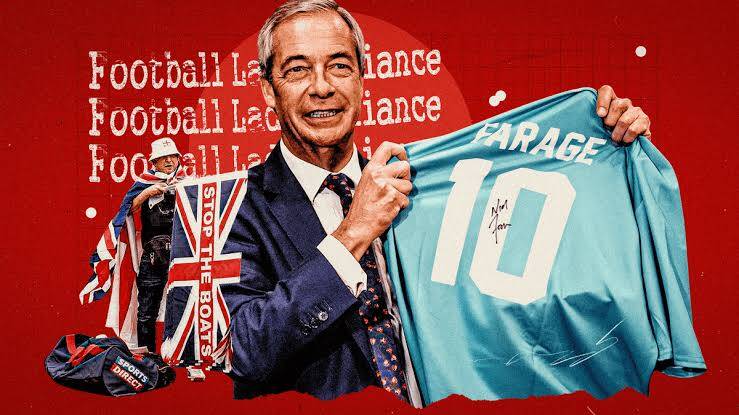
One of the clearest modern developments is the growing effort by political figures to associate themselves with football culture. Figures such as Nigel Farage, leader of Reform UK, have made public appearances at clubs like Ipswich Town. This reflects a broader attempt to connect with football supporters and tap into the strong sense of identity and community that exists within the game. For critics, this marks a shift from earlier rhetoric that often dismissed football fans as little more than hooligans, towards a more calculated effort to win their support.
This strategy mirrors patterns seen across decades: identifying spaces where collective identity is strong and attempting to embed political messaging within them. While football remains, for the overwhelming majority, an inclusive and diverse environment, its emotional intensity and community ties can make it an attractive target for those seeking to build influence.
At the same time, the role of digital platforms has amplified these efforts. Social media allows ideas to spread rapidly, often without the same level of scrutiny found in traditional spaces. Combined with real-world visibility, whether through fan engagement, or public appearances, this creates a dual approach that blends old and new tactics.
However, it is important to stress that the vast majority of football supporters reject far-right ideologies. Campaigns, supporter groups, and clubs themselves have increasingly taken active steps to challenge discrimination and promote inclusion within the game. The ongoing tension lies in ensuring that football remains a space defined by unity and shared passion, rather than division, despite continued attempts by fringe groups and individuals to shape it otherwise.
Football is meant to be about community, passion, and shared experience. The chants, the journeys, and the camaraderie all reflect a desire to belong. Yet, history shows that far-right groups have repeatedly tried to exploit that sense of belonging, from the National Front’s leaflets on terraces to the digital mobilisation of the EDL.
Today, the threat is more sophisticated. Social media amplifies extremist messaging, and even political figures have attempted to associate themselves with football to win influence. But this does not mean football should be ceded to division. Instead, it calls for vigilance. Fans, clubs, and communities must challenge racism and discrimination whenever they see it, refusing to let terraces become platforms for hate.
The game thrives on unity and shared joy, not on ideology that divides. Every fan faces a choice: ignore prejudice or confront it, let hatred spread or stand for inclusion. Football’s true power lies in bringing people together, across differing backgrounds, cultures, and beliefs. Protecting that space is not just a matter of loyalty to a club, it is a commitment to the spirit of the game itself.
Football can, and must, remain a space for everyone. It is up to supporters to ensure that passion and loyalty are never hijacked by those who seek to divide.